


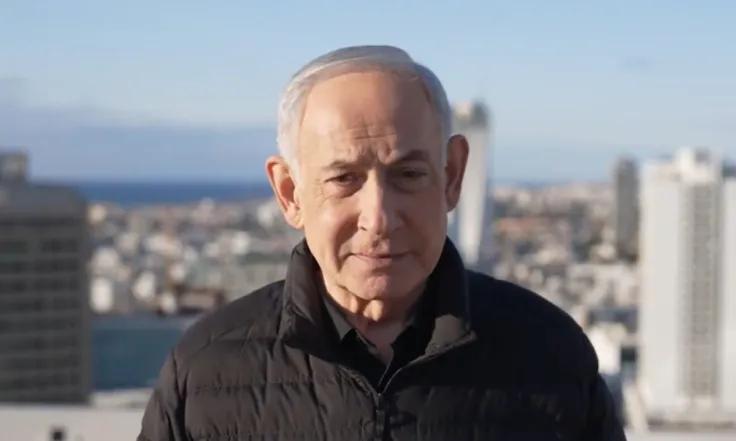
The sirens wailed across central Israel on Monday, a chilling prelude to what Palestinian militant groups claimed was a direct hit on the heart of Israel’s defense establishment. While Israeli authorities remained tight-lipped about the precise impact, reports quickly emerged of a missile strike near the Kirya, Tel Aviv’s heavily fortified military headquarters. Amidst the chaos and conflicting narratives, the immediate whereabouts of Prime Minister Benjamin Netanyahu became a subject of intense speculation, fueling a wider sense of unease across the nation already grappling with heightened tensions.
Hamas’s military wing, the Al-Qassam Brigades, swiftly took credit for the alleged attack, asserting they had launched a barrage of rockets targeting the Kirya. Their claims were echoed by Palestinian Islamic Jihad (PIJ), which also stated it had fired missiles towards Tel Aviv. While the Israeli Defense Forces (IDF) confirmed rocket fire from Gaza into central Israel, they offered no specific details regarding the location or extent of any damage, adhering to a policy of strategic ambiguity often employed during such escalations. This lack of official confirmation regarding the Kirya strike only intensified public curiosity and concern over the Prime Minister’s safety and location.
In the immediate aftermath, a spokesperson for the Prime Minister’s Office issued a brief statement acknowledging the rocket fire but made no mention of Netanyahu’s current location or whether he had been in the vicinity of the alleged strike. This silence, while perhaps intended to deny militant groups a propaganda victory, inadvertently amplified the uncertainty. The Kirya complex is not merely a military command center; it also houses the Ministry of Defense and is a frequent location for high-level government meetings, including those attended by the Prime Minister. Its strategic importance makes it a prime symbolic, if not always practical, target for adversaries.
The alleged strike on Tel Aviv unfolded against a backdrop of intensifying conflict in the Gaza Strip. The IDF had recently confirmed the death of Marwan Issa, a senior Hamas military commander, described as the group’s “deputy military chief.” Issa, known as “Shadow Man” due to his elusive nature, was reportedly killed in an Israeli airstrike on a tunnel complex in central Gaza earlier in March. His death, a significant blow to Hamas’s leadership, was confirmed by both the White House and Israeli officials. Jake Sullivan, the U.S. National Security Advisor, publicly stated that Issa was indeed deceased, a sentiment echoed by Israeli Prime Prime Minister Benjamin Netanyahu, who lauded the operation as a major success in dismantling Hamas.
This escalation, culminating in the alleged Tel Aviv strike, is inextricably linked to the ongoing conflict ignited by Hamas’s October 7 attacks on Israel. That brutal cross-border assault resulted in the deaths of approximately 1,200 people, predominantly civilians, and the abduction of around 250 individuals, many of whom remain captive in Gaza. Israel’s subsequent military response in Gaza has been extensive, leading to a severe humanitarian crisis within the besieged enclave and claiming the lives of over 31,000 Palestinians, according to the health ministry in Gaza. The cycle of violence continues to spiral, with each strike and counter-strike pushing the region further into instability.
As the dust settled on Monday’s events, the precise impact of the alleged missile strike on the Kirya remained unconfirmed by Israeli authorities. However, the claims by Palestinian militant groups, coupled with the Prime Minister’s undisclosed location, underscored the volatile and unpredictable nature of the conflict. The incident served as a stark reminder that even the most fortified centers of power in Israel remain vulnerable to attack, perpetuating a climate of fear and uncertainty for its citizens and a complex challenge for its leadership.