

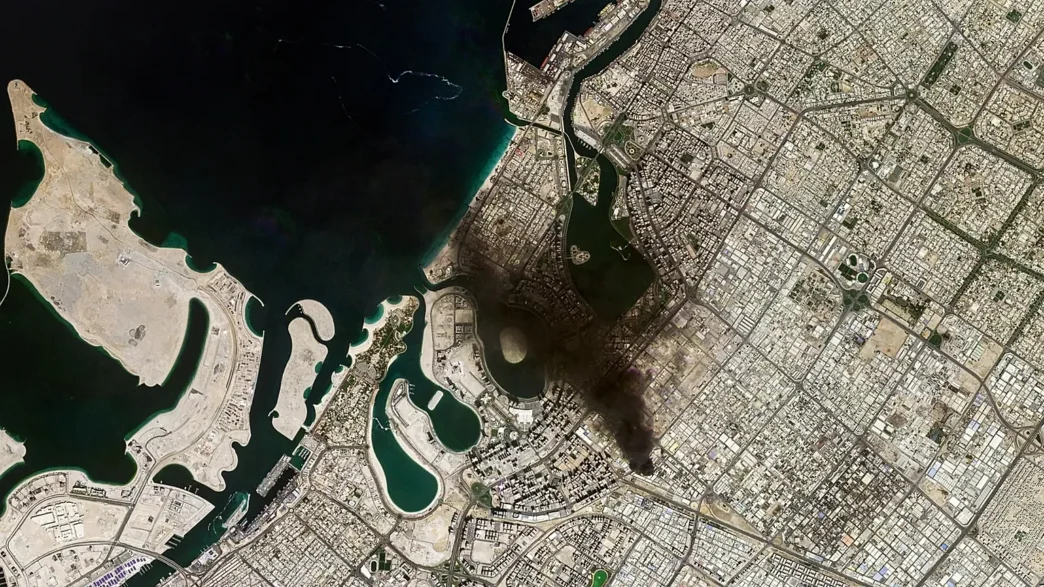
The recent barrage of Iranian drones and missiles targeting parts of the Gulf has prompted the United Arab Emirates to articulate a strategy centered on defense and regional containment, even as officials acknowledge a profound shift in their diplomatic outlook. Emirati officials, in a briefing from Abu Dhabi, revealed that the nation had been quietly preparing for widespread instability long before the current escalation, a testament to their long-term assessment of regional dynamics. This proactive stance included extensive measures such as bolstering food stocks and fortifying critical facilities, demonstrating a foresight that has proven crucial in the face of unexpected aggression.
Despite these preparations, the sheer scale of the attacks reportedly came as a surprise to Emirati leadership. Officials stated that while the country was ready for such contingencies, they “definitely did not expect” Iran to risk its relationships with all its neighbors in such a dramatic fashion. This sentiment underscores a deeper concern regarding the erosion of trust that these actions have engendered. The UAE, despite its constructive engagement with Tehran alongside other Gulf Cooperation Council states, now finds itself recalibrating its approach to regional security.
A cornerstone of the UAE’s immediate response has been the robust performance of its multi-layered air defense systems. These defenses have been actively intercepting incoming threats, with officials noting that the Iranian strategy to create regional havoc underestimated the Gulf states’ defensive capabilities. Crucially, these operations have not been conducted in isolation. International partners, particularly France, have played a significant role. French Rafale jets, operating under existing agreements, have been integral to ongoing air patrols, successfully intercepting drones and missiles since the onset of the crisis. This collaboration highlights a critical aspect of regional security, where alliances provide a crucial deterrent and defensive capability.
Looking beyond immediate defense, the UAE’s focus remains on shielding its population and infrastructure while striving to prevent the wider conflict from expanding. Officials have been clear that the Iranian aggression against non-combatant Gulf states must cease immediately. While advocating for deterrence and defense, there is a palpable desire to avoid further escalation. The belief within Emirati circles is that conflict rarely resolves critical issues, and a broader war would only exacerbate existing problems. This nuanced position seeks to balance the need for firm self-defense with a strategic imperative to de-escalate tensions and foster avenues for mediation.
The political ramifications of these attacks are expected to be far-reaching, fundamentally reshaping future negotiations with Iran. Emirati officials contend that any new settlement with Tehran can no longer be confined solely to its nuclear program. The proliferation and use of missiles are now considered central to any discussion, viewed not as defensive measures but as instruments of aggression. This shift in perspective signifies a more comprehensive approach to Iranian engagement, where missile capabilities will likely become a non-negotiable element. Moreover, while acknowledging the enduring reality of shared borders, the attacks have, in the words of one official, created a “huge trust gap” that could persist for decades, complicating future diplomatic endeavors.
Despite the prevailing uncertainty, the UAE maintains an optimistic outlook on its long-term stability and economic resilience. Officials believe that the nation’s fundamental strengths – an attractive society, a stable environment, a dynamic economy, and a favorable tax regime – will ultimately prevail. While the immediate danger is hoped to subside sooner rather than later, the formal conclusion of the conflict might take longer. Nevertheless, the anticipation is that these core attributes will ensure the UAE’s continued prosperity. The coming weeks are therefore critical for the UAE and its Gulf neighbors, as they navigate the immediate crisis, aiming to contain the confrontation and prevent it from spiraling into a broader regional conflagration.