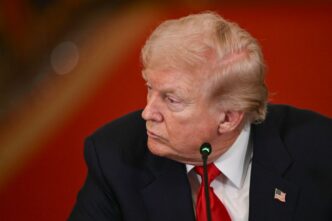

President Donald Trump recently offered an assessment suggesting a quick conclusion to a potential conflict with Iran, a statement that has prompted varied interpretations among foreign policy analysts and international observers. Speaking at a private event, Trump’s remarks underscored a belief that any confrontation would be decisive and brief, contrasting with historical precedents of protracted engagements in the region. His perspective appears to stem from a focus on overwhelming military capability as a deterrent and, if necessary, a swift instrument for achieving objectives.
The former president’s comments arrive amidst ongoing geopolitical tensions and a shifting landscape of alliances in the Middle East. While not elaborating on specific strategies or timelines, the underlying message conveyed a confidence in American military strength to navigate complex scenarios. This stance aligns with previous declarations made during his presidency, where he often emphasized a readiness to act unilaterally if perceived national interests were at stake, particularly concerning Iran’s nuclear program and its regional activities.
Observers note that such statements, whether intended as a warning or a prediction, inevitably resonate through diplomatic channels and military planning circles. The implication of a rapid resolution could be interpreted in several ways: as a deterrent meant to discourage escalatory actions, as a reflection of a specific strategic doctrine, or perhaps as a means to reassure domestic audiences about the manageability of potential international crises. However, the complexities of the region, characterized by interlocking interests and non-state actors, often defy straightforward predictions.
Historically, military engagements in the Middle East have rarely followed a simple trajectory, frequently involving unforeseen challenges and prolonged commitments. Experts point to the intricate web of regional power dynamics, the potential for proxy conflicts, and the varying motivations of state and non-state actors as factors that typically complicate any military intervention. Therefore, a declaration of a quick resolution, while projecting strength, also invites scrutiny regarding the operational realities and potential long-term consequences.
The current administration has largely maintained a policy of diplomatic engagement while also reinforcing strategic partnerships in the region. Trump’s recent remarks introduce another dimension to the public discourse surrounding Iran, highlighting a contrast in approaches to foreign policy and national security. Whether these statements are intended to shape future policy discussions or merely reflect a personal conviction, they undoubtedly contribute to the ongoing conversation about America’s role and posture in one of the world’s most volatile regions. The full implications of such declarations, particularly from a former commander-in-chief, often unfold over time as they are processed by various international stakeholders.