
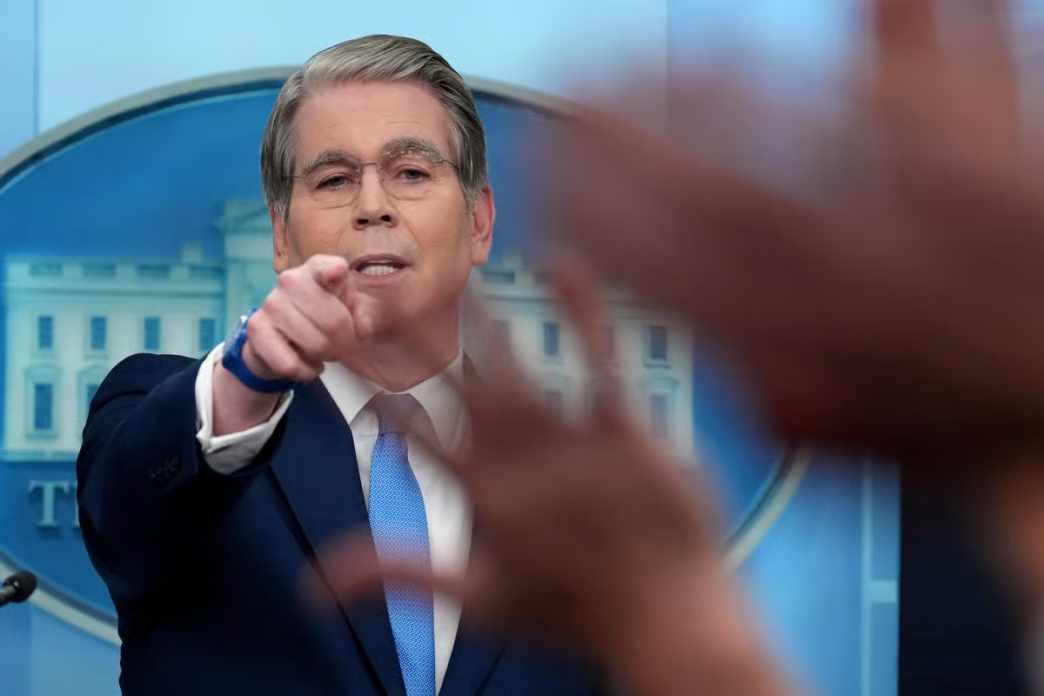
The diplomatic landscape surrounding Iran continues to be a focal point on the international stage, with President Donald Trump’s potential posture toward the nation drawing considerable speculation. Amidst this ongoing discussion, investment manager and political commentator Dan Bessent offered a clear perspective on what he believes would characterize any future engagement from a Trump administration. Bessent, known for his analysis of geopolitical trends and their economic implications, posited that the likelihood of Trump consenting to what he deems a “bad deal” with Iran is exceedingly low. This assertion stems from a deep understanding of Trump’s previous foreign policy approach and his consistent rhetoric regarding international agreements.
Bessent’s analysis frequently highlights Trump’s transactional view of diplomacy, where outcomes are measured by perceived benefits to American interests. In the context of Iran, this translates to a demand for significant concessions, particularly concerning its nuclear program and regional influence. The investment manager suggested that any agreement failing to meet these stringent criteria would simply not pass muster. This viewpoint aligns with the withdrawal from the Joint Comprehensive Plan of Action (JCPOA) in 2018, a decision predicated on the belief that the agreement was fundamentally flawed and did not adequately prevent Iran from developing nuclear weapons in the long term.
The discussion around a “bad deal” often centers on the specifics of nuclear enrichment capabilities, ballistic missile development, and Iran’s support for various proxy groups across the Middle East. Bessent indicated that Trump’s administration would likely push for more comprehensive restrictions than those outlined in the original JCPOA, possibly including perpetual limitations on enrichment and more robust verification mechanisms. Furthermore, he alluded to the financial penalties and sanctions that have been a cornerstone of Trump’s strategy, suggesting these would remain powerful leverage in any future negotiations. The aim, as Bessent interprets it, would be to compel Iran into an agreement that demonstrably curtails its strategic capabilities, rather than simply delaying them.
Considering the domestic political climate in both the United States and Iran, the path to any new agreement is fraught with challenges. Bessent underscored the deep mistrust that characterizes the relationship, a factor that complicates even preliminary discussions. He pointed out that for any deal to gain traction, it would need to overcome decades of animosity and a complex web of regional rivalries. From Trump’s perspective, the objective would be to secure an agreement so unequivocally favorable to American interests that it would be difficult for future administrations to dismantle, a characteristic he often sought in his previous international dealings.
Ultimately, Bessent’s commentary paints a picture of a potential second Trump administration approaching Iran with a clear, uncompromising mandate. The expectation is not merely for a renegotiation, but for a fundamental reshaping of the terms of engagement, driven by a perceived need for stronger safeguards and more definitive assurances. The concept of a “bad deal,” in this framework, extends beyond mere optics to encompass any agreement that does not decisively address proliferation concerns and regional destabilization. This perspective suggests that while dialogue might eventually resume, the bar for an acceptable outcome would be set exceptionally high.