
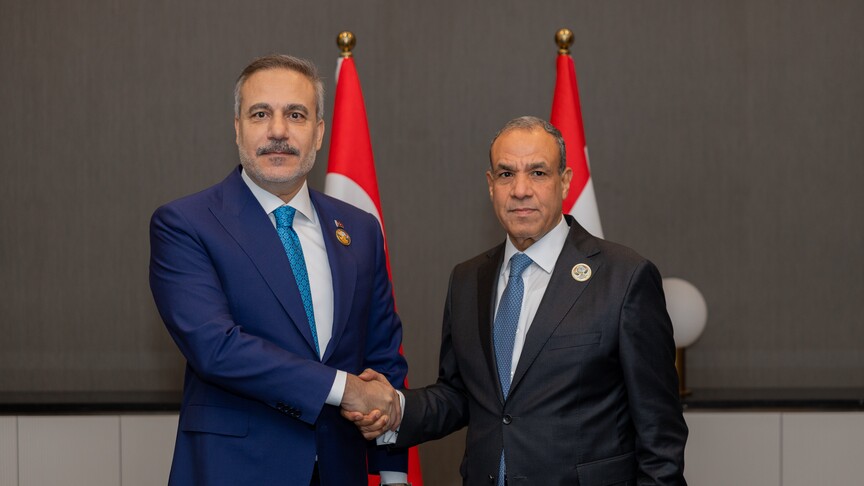
Turkish Foreign Minister Hakan Fidan spoke with his Egyptian counterpart Badr Abdelatty by phone on Saturday, Turkish diplomatic sources said. The two ministers discussed developments in the Middle East and the Eastern Mediterranean, two regions where Ankara and Cairo have been working to deepen coordination after years of cooler relations.
Photo: Anadolu Agency
Rebuilding ties
The call comes at a time when Turkey and Egypt have been gradually rebuilding a relationship that frayed badly after 2013. Ankara and Cairo found themselves on opposite sides of the Arab Spring uprisings and its aftermath, with Turkey backing Islamist political movements while Egypt’s leadership moved in a different direction. Diplomatic relations were downgraded for years.
More recently, both governments have concluded that closer ties serve their interests. Trade has expanded, intelligence contacts have resumed, and senior officials have visited each other’s capitals. The phone conversation between Fidan and Abdelatty is the latest sign that the two countries now treat each other as relevant partners on regional questions, even when they do not agree on every issue.
Gaza and the Eastern Mediterranean
The Middle East portion of the conversation almost certainly touched on the war in Gaza and its ripple effects across the region. Turkey and Egypt both border the Mediterranean and both have stakes in how the conflict evolves. Egypt has acted as a key mediator in ceasefire efforts and has warned repeatedly against any displacement of Palestinians into the Sinai Peninsula. Turkey has been among the most vocal critics of Israel’s military campaign and has pushed for stronger international pressure for a ceasefire.
The Eastern Mediterranean is another area where the two countries have overlapping interests. The region’s offshore gas fields have made it a strategic prize, and competing maritime claims have drawn in Turkey, Greece, Cyprus, Egypt, and others. Turkey has objected to agreements that it says exclude it from energy projects in the area, while Egypt has positioned itself as an emerging energy hub with liquefaction facilities on its north coast.
Libya and broader security
Beyond Gaza and energy, Libya remains a shared concern. Turkey and Egypt have backed rival factions in Libya's long civil conflict, although both have publicly supported a UN-led political process. Any progress toward stabilizing Libya would require Turkish and Egyptian buy-in, making their channels of communication valuable even when their preferences differ.
Security cooperation is also likely on the agenda. Both countries face threats from militant groups, and both have an interest in curbing instability in the Red Sea and the Horn of Africa. The phone call suggests that routine diplomatic contact between Ankara and Cairo now covers a wide agenda rather than single issues.
What the call signals
While the Turkish readout of the call was brief, the very fact that Fidan and Abdelatty are speaking regularly matters. It reflects a broader trend in the Middle East toward pragmatic diplomacy, where rivalries are managed rather than escalated. For Turkey, improved ties with Egypt reduce isolation in the Arab world. For Egypt, a working relationship with Turkey adds leverage in its dealings with other regional powers.
Neither country is pretending that historical disagreements have vanished. But both appear to have decided that open lines of communication are preferable to public hostility. Saturday's conversation is likely to be followed by more, as the Middle East and Eastern Mediterranean continue to generate crises that no single capital can manage alone.